Report of
FNCA 2007 Mutation Breeding Project Workshop
November 19 - 23, 2007
Daejeon, Korea
Following the agreement at the Eighth Coordinators Meeting 2007 in Tokyo, Japan, the FNCA 2007 Workshop on Mutation Breeding took place as follows;
| Date : |
November 19-23, 2007 |
| Venue : |
Nuclear Human Resource Development Center (NHRDC)
Korea Atomic Energy Research Institute (KAERI)
Daejeon Metropolitan City
Korea |
| Host Organization : |
Ministry of Education, Culture, Sport, Science and Technology (MEXT), Japan
Korea Atomic Energy Research Institute (KAERI) |
| Secretariat : |
Nuclear Safety Research Association (NSRA), Japan |
| Participants : |
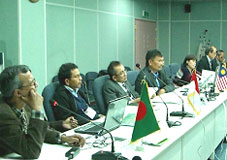
Total 21 from 8 countries, i.e. Bangladesh, Indonesia, Japan, Korea, Malaysia, the Philippines, Thailand and Viet Nam(Attachment II) |
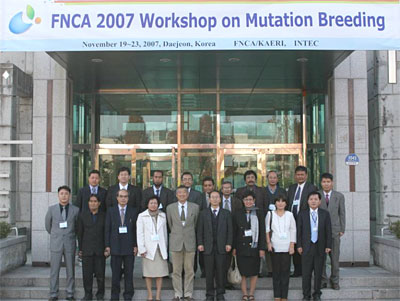 |
| The participants from 8 countries |
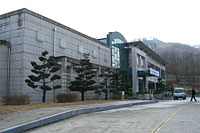 Opening Session and Open Lecture Opening Session and Open Lecture
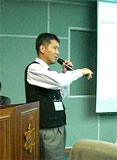
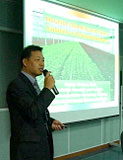
This Workshop began with the opening address by Dr. Sung Kee Cho (Director, Radiation Research Center for Bio-technology, ARTI-KAERI), following the opening address, Project Review of FNCA Mutation Breeding Project was delivered by Dr. Hitoshi Nakagawa (Project Leader of Japan), and followed by three special lectures by Japan and Korea as follows.
- "Establishment of Ion Beam Technology"
(Dr. Atsushi Tanaka, JAEA, Japan)
- "Mutation Breeding and Gene Isolation in Chrysanthemum"
(Dr. Geung Joo Lee, KAERI, Korea)
- "High Amino Acid Accumulating Rice Mutants"
(Dr. Dong Sub Kim, KAERI, Korea)
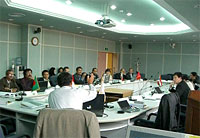 Country Report Country Report
Each participating country (Bangladesh, Indonesia, Japan, Malaysia, The Philippines, Thailand, Vietnam and Korea) presented their progress and general reports on Mutation Breeding in each country.
Sub-Project on Disease Resistance in Banana
The reports on Sub-project on Disease Resistance in Banana was presented by Malaysia and Indonesia, after that all participants discussed and decided about some themes about this sub-project as following.
| - |
Indonesia has been terminated this sub-Project at the end of 2006. |
| - |
A Special meeting of sub-project on disease resistance in banana in 2008 is proposed to be held either in Malaysia, Philippines or Japan and all the participating countries submit the final report. |
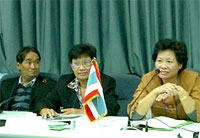 Sub- Project on Insect Resistance in Orchid Sub- Project on Insect Resistance in Orchid
The final report of Sub-Project Meeting on Insect Resistance in Orchid was presented by Assoc. Prof. Arunee Wongpiyasatid (Kasetsart University, Thailand), and proposed to extend the project for another 2 years until 2009.
It is discussed among the participants and all participants agreed to extend and support the project for another 2 years until 2009.
Sub- Project Composition or Quality in Rice
At the Starting this session, Special lectures were delivered by Korea as follows.
- "Rice genetic resources by mutation and their exploitation"
(Dr. Young Sub Shin, RDA, Korea)
- "Analysis methods for functional compounds in rice"
(Prof. Young Sang Lee, Soonchunhyang Univ. Korea)
The reports on Sub-project on Composition or Quality in Rice was presented by all participating countries. After the presentations, the Agreement about exchange breeding material, a standard variety/ methodology, and general rules and regulations was made to proceed with the project the future work plan were discussed and accepted.
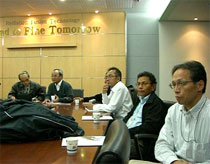
Round Table Discussion
The participants discussed about duties and responsibilities of the Project Leaders, and identified the role as follows.
| - |
To collect all the progress reports from the Sub-Project Leaders |
| - |
To compile all the reports and send to the secretariat before the meeting |
| - |
To present the report during meeting if the Sub-Project Leader do not participate. |
| - |
The Project Leader, as a leader of mutation breeding researches in his or her country, will take part in coordinating and management of the Mutation Breeding Project and need to communicate with the Sub-Project Leader. |
Technical Visit
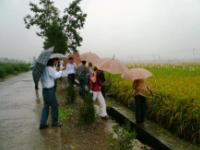
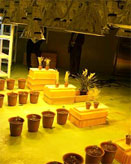
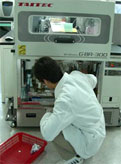
Participants made a technical visit to Advanced Radiation Technology Institute (ARTI) of KAERI. They watched Video of introduction and explanation about ARTI, then visit at many laboratories and facility.
|
Minutes of
FNCA 2007 Mutation Breeding Project Workshop
November 19 - 23, 2007
Daejeon, Korea
The FNCA 2007 Mutation Breeding Project Workshop took place as follows;
| Date : |
November 19-23, 2007 |
| Venue : |
Nuclear Human Resource Development Center (NHRDC)
Korea Atomic Energy Research Institute (KAERI)
Daejeon Metropolitan City
Korea |
| Host Organization : |
Ministry of Education, Culture, Sport, Science and Technology (MEXT), Japan
Korea Atomic Energy Research Institute (KAERI) |
| Secretariat : |
Nuclear Safety Research Association (NSRA), Japan |
| Participants : |
Total 21 from 8 countries, i.e. Bangladesh, Indonesia, Japan, Korea, Malaysia, the Philippines, Thailand and Viet Nam
(Attachment II) |
Opening Session
The session began with the opening address by Dr. Sung Kee Cho (Director, Radiation Research Center for Bio-technology, ARTI-KAERI).
Session 1 Open Lecture 1
Project Review of FNCA Mutation Breeding Project was delivered by Dr. Hitoshi Nakagawa (Project Leader of Japan), and followed by three special lectures by Japan and Korea as follows.
| -Special Lecture 1: |
Title “Establishment of Ion Beam Technology”
( Dr. Atsushi Tanaka, JAEA, Japan) |
| -Special Lecture 2: |
Title “Mutation Breeding and Gene Isolation in Chrysanthemum”
(Dr. Geung Joo Lee, KAERI, Korea ) |
| -Special Lecture 3: |
Title “High Amino Acid Accumulating Rice Mutants”
(Dr. Dong Sub Kim, KAERI, Korea) |
Session 2 Country Report
Each participating country (Bangladesh, Indonesia, Japan, Malaysia, The Philippines, Thailand, Vietnam and Korea) presented their progress and general reports on Mutation Breeding in each country.
Attachment III: Country reports
Session 3 Sub-Project on Disease Resistance in Banana
The reports on Sub-project on Disease Resistance in Banana was presented by Dr. Masrizal (State ministry of Research and Technology, Indonesia) and Dr. Rusli Ibrahim (Malaysian Nuclear Agency, Malaysia). The progress Reports were not submitted from other participating countries (Bangladesh, the Philippines and Vietnam) because of miscommunication.
Attachment IV: Sub-project for banana
In the presentation, comments and recommendations are pointed as follows:
| - |
The importance of screening for virus using ELISA was recommended especially for BBTV, but the test is expensive. |
| - |
The project on banana for Indonesia has already been terminated at the end of 2006 due to lack of budget. |
| - |
Currently, the project in Malaysia is in collaboration with a private company called Jalur Lipur Sdn. Bhd. which supported the field screening for Fusarium wilt disease and Malaysia will continue the project until 2008. |
| - |
A Special meeting of sub-project on disease resistance in banana in 2008 is proposed to be held either in Malaysia, Philippines or Japan. All the participating countries must submit the final report. |
| - |
Participating countries (Bangladesh, the Philippines and Vietnam) that did not submit progress reports during this workshop must send their reports to the secretariat (NSRA). |
Session 4 Report Sub- Project Meeting on Insect Resistance in Orchid
The final report of Sub-Project Meeting on Insect Resistance in Orchid was presented by Assoc. Prof. Arunee Wongpiyasatid (Kasetsart University, Thailand)
Attachment V: Sub-project for orchid
Conclusion is as follows;
Due to the fact that there was no potential mutant obtained, therefore during the Sub-Project Meeting on Insect Resistance on Orchid which was held at Kasetsart University, Thailand in August 2007, FNCA proposed to extend the project for another 2 years until 2009.
Project Leaders from all the participating countries gave the following responses to the proposal of the Orchid Special Meeting:
| Indonesia: |
|
did not agree to extend the project. |
| Malaysia: |
|
agreed to extend the project. Currently Nuclear Malaysia has a project with JAEA on the improvement of Orchid using ion beam. |
| Thailand: |
|
did not agree to extend the project. |
Even though Malaysia is the only participating country that agreed to continue with the project, all participants agreed to extend and support the project for another 2 years until 2009.
Session 5 Open Lecture 2 and Sub- Project Composition or Quality in Rice
Special lectures were delivered by Korea as follows.
| -Special Lecture 4: |
Title “Rice genetic resources by mutation and their exploitation”
(Dr. Young Sub Shin, RDA, Korea ) |
| -Special Lecture 5: |
Title “Analysis methods for functional compounds in rice“
(Prof. Young Sang Lee, Soonchunhyang Univ. Korea ) |
The reports on Sub-project on Composition or Quality in Rice was presented by all participating countries.
Attachment VI: Sub-project for Rice
After the discussion, the Agreement was made to proceed with the project.
Attachment VII: Agreement of Sub-Project on Rice
Session 6 Round Table Discussion
Duties and responsibilities of the Project Leaders,
| - |
To collect all the progress reports from the Sub-Project Leaders |
| - |
To compile all the reports and send to the secretariat (NSRA) before the meeting |
| - |
To present the report during meeting if the Sub-Project Leader do not participate. |
| - |
The Project Leader, as a leader of mutation breeding researches in his or her country, will take part in coordinating and management of the Mutation Breeding Project and need to communicate with the Sub-Project Leader. |
Minutes
The Minutes were discussed and agreed upon by all participants in the workshop. This will be reported at the Ninth Coordinators Meeting to be held in March 2008 in Tokyo, Japan
Technical Visit
Participants made a technical visit to Advanced Radiation Technology Institute of KAERI.
Attachments:
- Program
- Participants List
- Country Report
- Sub-project for banana
- Sub-project for orchid
- Sub-project for rice
- Agreement of Sub-Project on Rice
Program of
FNCA 2007 Workshop on Mutation Breeding
November 19 - 23, 2007
Daejeon Metropolitan City, Korea
| Date : |
November 19-23, 2007 |
| Venue : |
Nuclear Human Resource Development Center(NHRDC)
Korea Atomic Energy Research Institute (KAERI)
Daejeon Metropolitan City
Korea |
Host
Organization : |
Ministry of Education, Culture, Sport, Science and Technology(MEXT), Japan
Korea Atomic Energy Research Institute (KAERI) |
| Secretariat : |
Nuclear Safety Research Association (NSRA) |
Working
Language : |
English |
| |
| Mon., 19 November |
| Opening Session |
| 08:30 - 09:00 |
Registration |
| 09:00 - 09:20 |
Opening Address: Dr. Sung Kee Cho (Director, Radiation Research Center for Bio-technology, ARTI-KAERI ) |
| 09:20 - 09:50 |
Group photo and Break |
Session 1 Open Lecture 1
Chair : Japan |
| 09:50 - 10:15 |
Project Review of FNCA Mutation Breeding Project ( Hitoshi Nakagawa, Project Leader of Japan ) |
| 10:15 - 10:45 |
Special Lecture 1: Title “Establishment of Ion Beam Technology” ( Dr. Atsushi Tanaka, JAEA, Japan) |
| 10:45 - 11:15 |
Special Lecture 2: Title “Mutation Breeding and Gene Isolation in Chrysanthemum ” (Dr. Geung Joo Lee, KAERI, Korea ) |
| 11:15 - 11:45 |
Special Lecture 3: Title “High Amino Acid Accumulating Rice Mutants” ( Dr. Dong Sub Kim, KAERI, Korea) |
| 11:45 - 13:00 |
Congratulation Reception (Lunch) |
Session 2 Country Report
Chair : The Philippines |
| 13:00 - 13:20 |
Bangladesh |
| 13:20 - 13:40 |
Indonesia |
| 13:40 - 14:00 |
Japan |
| 14:00 - 14:20 |
Malaysia |
| 14:20 - 14:40 |
The Philippines |
| 14:40 - 15:00 |
Break |
| 15:00 - 15:20 |
Thailand |
| 15:20 - 15:40 |
Viet Nam |
| 15:40 - 16:00 |
Korea |
| 16:00 - 16:45 |
Discussion, Question and Answer |
| Tue., 20 November |
Session 3 Sub-Project Disease Resistance in Banana
Chair : Thailand |
| 09:00 - 09:30 |
Indonesia |
| 09:30 - 10:00 |
Malaysia |
| 10:00 - 10:30 |
Break |
| 10:30 - 11:00 |
Discussion on Disease Resistance in Banana |
| Session 4 Report Sub- Project Meeting on Insect Resistance in Orchid |
| 11:00 - 11:30 |
Report of Sub-Project Meeting on Insect Resistance in Orchid
(Assoc. Prof. Arunee Wongpiyasatid, Kasetsart University, Thailand ) |
| 11:30 - 12:00 |
Discussion on Insect Resistance in Orchid |
| 12:00 - 13:00 |
Lunch |
Cont. of Session 4 Report Sub- Project Meeting on Insect Resistance in Orchid
Chair : Japan |
| 13:00 - 13:45 |
Discussion on Insect Resistance in Orchid (Cont.) |
| 13:45 - 14:40 |
Discussion on Future Plan and Prospect of MB Project |
| 14:40 - 15:00 |
Break |
Session 5 Open Lecture 2 and Sub- Project Composition or Quality in Rice
Chair : Japan, Viet Nam |
| 15:00 - 15:30 |
Special Lecture 4: Title “Rice genetic resources by mutation and their exploitation” (Dr. Young Sub Shin, RDA, Korea ) |
| 15:30 - 16:00 |
Special Lecture 5: Title “Analysis methods for functional compounds in rice “ (Prof. Young Sang Lee, Soonchunhyang Univ. Korea ) |
| 16:00 - 16:10 |
Break |
| 16:10 - 16:35 |
Japan ( Dr. Minoru Nishimura, IRB, NIAS, Japan ) |
| 16:35 - 17:00 |
Discussion, Question and Answer |
| Wed., 21 November |
Cont. of Session 5 Sub- Project Composition or Quality in Rice
Chair : Indonesia |
| 09:00 - 09:30 |
Bangladesh |
| 09:30 - 10:00 |
Indonesia |
| 10:00 - 10:30 |
Korea |
| 10:30 - 10:50 |
Break |
| 10:50 - 11:20 |
Malaysia |
| 11:20 - 11:50 |
Discussion, Question and Answer |
| 11:50 - 13:00 |
Lunch |
Cont. of Session 5 Sub- Project Composition or Quality in Rice
Chair : Korea |
| 13:00 - 13:30 |
The Philippine |
| 13:30 - 14:00 |
Thailand |
| 14:00 - 14:30 |
Viet Nam |
| 14:30 - 14:45 |
Break |
| 14:45 - 15:45 |
Discussion about Working Plan on Rice Project |
| 15:45 - 16:45 |
Discussion about Agreement on Rice Project |
| Thu., 22 November |
| Technical Visit to Advanced Radiation Technology Institute of KAERI |
| Fri., 23 November |
Cont. of Session 5 Sub- Project Composition or Quality in Rice
Chair : Japan |
| 09:00 - 10:30 |
Agreement on Rice Project |
| 10:30 - 10:45 |
Break |
| 10:45 - 11:45 |
Discussion about Working Plan on Rice Project |
| 11:45 - 13:15 |
Lunch |
| 13:15 - 14:30 |
Discussion about Working Plan on Rice Project |
| 14:30 - 14:45 |
Break |
Session 6 Round Table Discussion
Chair : Japan |
| 14:45 - 16:00 |
Discussion on Future Plan and Prospect of MB Project |
| 16:00 - 16:45 |
Drafting Minutes and Wrap up : Adoption of Minutes |
| 16:45 - 17:00 |
Closing |
List of Participants
FNCA 2007 Mutation Breeding Project Workshop
November 19 - 23, 2007
Daejeon, Korea
No. |
Country |
Name/Designation |
| 1 |
Bangladesh |
Dr. Md. Lokman Hakim
Principal Scientific Officer
Institute of Food & Radiation Biology, Atomic Energy Research Establishment
Bangladesh Atomic Energy Commission (BAEC) |
| 2 |
Bangladesh |
Mr. Golam Ahmed
Principal Scientific Officer
Plant Biotechnology and Genetic Engineering Division
Institute of Food and Radiation Biology
Bangladesh Atomic Energy Commission (BAEC) |
| 3 |
Indonesia |
Dr. Masrizal
Assistant Deputy for Networking System of Science and Technology
The State Ministry of Research and Technology of Indonesia |
| 4 |
Indonesia |
Dr. Sobrizal
Senior Research Officer
Center for the Application of Isotopes and Radiation Technology
National Nuclear Energy Agency (BATAN) |
| 5 |
Japan |
Dr. Hitoshi Nakagawa
Director
Institute of Radiation Breeding
Division of Genome and Biodiversity Research
National Institute of Agrobiological Sciences (NIAS) |
| 6 |
Japan |
Dr. Atsusi Tanaka
Unit Manager
Radiation-applied Biology Division
Quantum Beam Science Directorate
Japan Atomic Energy Agency (JAEA) |
| 7 |
Japan |
Dr. Minoru Nishimura
Senior Officer
Institute of Radiation Breeding
Division of Genome and Biodiversity Research
National Institute of Agrobiological Sciences (NIAS) |
| 8 |
Japan
(Secretariat) |
Ms. Aki Koike
International Affairs and Research Department
Nuclear Safety Research Association (NSRA) |
| 9 |
Korea |
Dr. Si-Yong Kang
Principal Researcher, Project Leader
Advanced Radiation Technology Institute (ARTI)
Korea Atomic Energy Research Institute (KAERI) |
| 10 |
Korea
(Secretariat) |
Ms. Kyungmee Yoo
Nuclear Human Resource Development Center(NHRDC)
Korea Atomic Energy Research Institute(KAERI) |
| 11 |
Korea |
Dr. Geung-Joo Lee
Senior Researcher
Advanced Radiation Technology Institute (ARTI)
Korea Atomic Energy Research Institute (KAERI) |
| 12 |
Korea |
Dr. Dong Sub Kim
Senior Researcher,
Advanced Radiation Technology Institute (ARTI)
Korea Atomic Energy Research Institute (KAERI) |
| 13 |
Korea |
Dr. Young Sub Shin
Senior Researcher
Institute of Crop Science
Rural Development Administration (RDA), Korea |
| 14 |
Korea |
Dr. Young Sang Lee
Prof., Soonchunhyang Univ. Korea |
| 15 |
Malaysia |
Dr. Rusli Bin Ibrahim
Rice Breeder
Agrotechnology & Biosciences Division
Malaysian Nuclear Agency (Nuclear Malaysia) |
| 16 |
Malaysia |
Dr. Abdul Rahim Harun
Senior Research Officer
Agrotechnology & Biosciences Division
Malaysian Nuclear Agency (Nuclear Malaysia) |
| 17 |
The Philippines |
Ms. Faye G. Rivera
Science Research Specialist II
Philippine Nuclear Research Institute (PNRI) |
| 18 |
Thailand |
Assoc. Prof. Arunee Wongpiyasatid
Associate Professor
Department of Radiation and IsotopesFaculty of ScienceKasetsart University (KU) |
| 19 |
Thailand |
Mr. Suniyom Taprab
Plant Breeder
Rice Department
Ministry of Agriculture and Cooperatives |
| 20 |
Thailand |
Ms. Dara Chettanachit
Senior Expert
Rice Department
Ministry of Agriculture and Cooperatives |
| 21 |
Viet Nam |
Dr. Mai Quang Vinh
Director
Centre For Consultancy and Technology Transfer in Agriculture, National Institute of Agricultural Genetics (AGI) |
| 22 |
Viet Nam |
Dr. Le Xuan Tham
Deputy Director
Center for Nuclear Techniques Ho Chi Minh City
Vietnam Atomic Energy Commission (VAEC) |
Agreement of Sub-Project on Rice
| 1. |
Agreement on the exchange breeding material under the framework of FNCA Mutation Breeding Project |
| General Rules and Regulations: |
| 1) |
FNCA should be the coordinating agency for facilitating exchange program. |
| 2) |
There must be Material Transfer Agreement (MTA) between two institutions involved |
| 2. |
Request for use of irradiation such as Ion beam, Gamma Ray Chronic Irradiation for participating countries must be channelized through the Secretariat Office. |
| 3. |
A standard variety/ methodology shall be used by all participating countries
Standard variety for both amylose and protein content (IR-64 for Indica rice and Koshihikari for Japonica rice). |
| Methodology: |
| 1) |
Amylose content shall be determined using the IRRI method. |
| 2) |
Protein content shall be determined by kjeldahl method. |
| 3) |
Simple standardized method for preliminary screening of amylose content shall be used in M2 or M3 generations (Thailand or IRRI method). |
| 4) |
A conventional SDS-PAGE method to analyze digestible and indigestible protein will be provided by IRB, Japan. |
|
|