MENU
|
| FNCA 2008 Workshop on Radiation Safety and Radioactive Waste Management |
Report of
FNCA2008 Workshop on
Radiation Safety and Radioactive Waste Management (RS&RWM)
November 3 - 7
Sydney, Australia
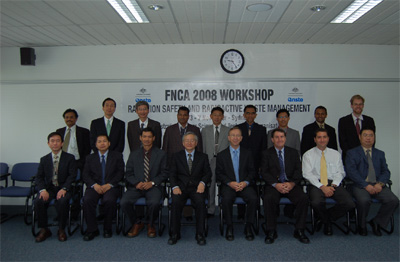
FNCA2008 Workshop on the Radiation Safety and Radioactive Waste Management(RS&RWM)was held in Sydney Australia from November 3 to 7, 2008, hosted by the Ministry of Education, Culture, Sports, Science and Technology (MEXT) of Japan and the Australian Nuclear Science and Technology Organisation (ANSTO), as a local host organization, in cooperation with the Nuclear Safety Research Association (NSRA) of Japan. Thirteen specialists on this field attended the Workshop and had an information exchange and discussion about radiation safety and radioactive waste management.
| |
 |
| |
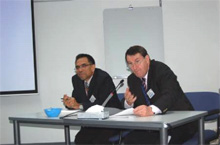
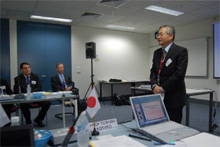
Dr. Ron Cameron (ANSTO)
Coordinator of Australia |
| |
 |
| |
Prof. Toshiso Kosako
(the University of Tokyo)
Project Leader of Japan
|
1) the Outline of the workshop
As a new project, the FNCA Radiation Safety and Radioactive Waste Management (RS&RWM) project superseded the Radioactive Waste Management (RWM) project, which started in 1995 and have been lead to promotion of good comprehension at the technical viewpoint among FNCA countries. The new RS&RWM project started in 2008 with an aim for enhancing the safety concerning radiation safety and radioactive waste management in Asian area through such activities as exchanging and sharing various precious information and experiences in this fields among participating countries. The main activity of this project is to hold a workshop every year that is expected to be held among participating countries in turn.
This workshop is the first one titled Radiation Safety and Radioactive Waste Management, and thirteen specialists from eight countries took part in the meeting; Australia, Bangladesh, China, Indonesia, Japan, Malaysia, Thailand and Vietnam. The specialists who are in charge of Radiation Safety and/or Radioactive Waste Management made information and experiences exchange through providing country reports, sub-meetings, round table discussion on various themes such as decision making, regulation, operation, R&D and so on. Additionally ANSTO kindly provided a technical visit to the ANSTO facilities.
2) the Outline of the Workshop
i) Time: November 3-7, 2008
ii) Place: Sydney Australia
iii) Sponcor: ANSTO and MEXT
iv) Participation: Australia2, Bangladesh1, China1, Indonesia1, Japan4, Malyasia1, Thailand2 and Vietnam1; total 13 (see attached file)
v) Schedule: See attached file
On the first day, following the opening remarks from Mr. Lubi Dimitrovski (ANSTO & Project Leader of Australia), Dr. Ron Cameron (Acting CEO ANSTO & FNCA Coordinator) presented the Opening Address. Then Professor Toshiso Kosako provided the Keynote FNCA Address as the Project Leader of Japan. Session 1 consisted of an explanatory lecture on the theme of Radiation Safety Principles provided by Dr. Toshiso Kosako. In Session 2, the country reports were presented on the present status and progress in radiation safety and radioactive waste management in each FNCA country. At the end of Session 2 a Poster/Mini-Exhibition was held to facilitate enhancement and understanding of the relative important activities in RS & RWM among the FNCA countries.
 |
|
|
|
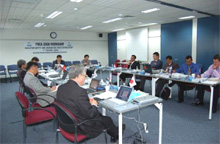
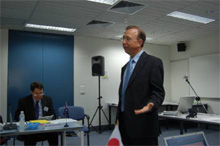
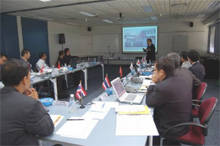
A Scene of Session 1
Presentation by Professor Kosako
Dr. Toshiso Kosako made a presentation as basic information on Radiation Safety and each country reports were delivered. |
|
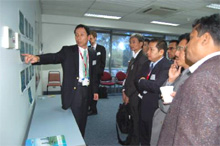
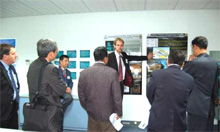
A Scene of Poster Session
Presentation by Mr. Oumi
Mr. Tadashi Oumi showed actual practices at the Japanese nuclear power plants. |
 |
|
|
|
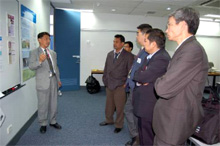
A Scene of Poster Session
Presentation by Dr. Hattori
Dr. Takatoshi Hattori showed some example of radiation measurement in Japan and introduced the next AOCRP3, which will be held in Japan in 2010. |
|
A Scene of Poster Session
Presentation by Mr. Kemp (ANSTO)
Mr. Duncan Kemp (ANSTO) showed some examples of Radioactive Waste Management and risk and security on orphan sources, and introduced the commissioning and operation of OPAL. |
On the second day, Sessions 3 and 4 were presented. Session 3 provided country topics on specific radiation safety issues. Topics included examples and experiences in radiation measurements using personal dosimeters, decommissioning management involving mixed wastes (radioactive and asbestos), spent source disposal issues, dose constraint, and discharge limits determination. Session 4 focused on radioactive waste management within two specific themes. Theme 1 comprised of two presentations relating to siting of radioactive waste facilities and Theme 2 consisted of two presentations on specific safety issues relating to radioactive waste management. The Session 4 topics were voluntary and presented by Australia, Bangladesh, Thailand and Japan. After Session 4, a technical visit to ANSTO 's waste operation facilities was conducted.
 |
|
|
|
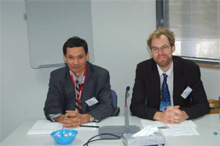
Dr. U. Youngchuay (TINT) and
Mr. D. Kemp (ANSTO) |
|
Mr. Syahrir (BATAN) and
Mr. L. Dimitrovski (ANSTO) |
 |
|
|
|
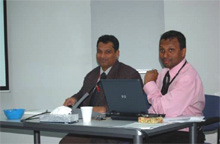
Mr. M. Islam (BAEC) and
Mr. K. Fernando (ANSTO) |
|
|
On the third day, a technical visit was made to the HIFAR & MOATA research reactors, both under various stages of decommissioning. Following this, ANSTO 's Low Level Waste Storage Facility, the OPAL Reactor and Bragg Institute of ANSTO were also visited by the participants. The technical tour provided an insight into operational issues relating to radiation safety and radioactive waste management.
 |
|
|
|
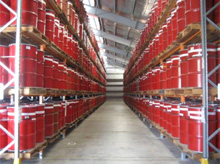
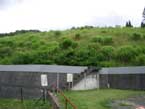
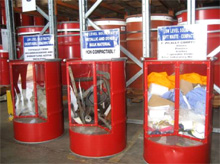
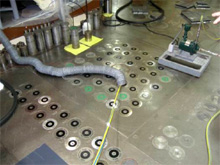
Drums for Low Level Solid Waste
Left : Concrete Blocks
Middle : Metallic Bulk (Non Compactable)
Right : Soft Waste (Compactable)
|
|
Drums for Low Level Solid Waste Inside of the Storage Building
|
 |
|
|
|
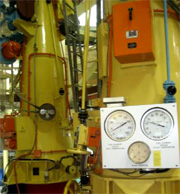
Top of the HIFAR reactor
HIFAR was powered by 25 fuel elements each containing 280g of uranium.
|
|
Transfer Flask for spent fuel of HIFAR
Every four weeks, three or four spent elements are removed from the reactor using a specially designed transfer flask and put into a small pond adjacent to the reactor.
|
| |
 |
| |
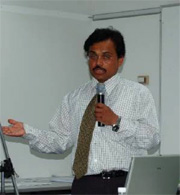
The Outline of the Regulation by ARPANSA
Dr. S. Sarkar (ARPANSA) |
Session 6 consisted of a Round-Table discussion on 'Future cooperation with other international programs such as IAEA/ANSN and RCA/RAS9042' provided by all participants.
The "RS & RWM 3-Year Work Plan for 2008-2010" under the FNCA framework was discussed and successfully concluded.
| |
 |
| |
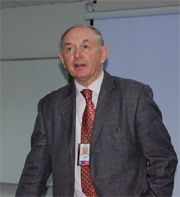
Mr. J. Easey (ANSTO) |
Dr. John Easey, who is the Senior Adviser of ANSTO and who has been engaged in the international and regional liaison, gave his acknowledgment toward FNCA activities as a worthy international cooperation and showed his expectation on the making forward of the new titled project.
| |
 |
| |
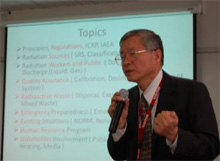
The overview by Professor T. Kosako |
All FNCA Project Leaders recognized the valuable technical discussions and networking opportunities provided by the FNCA RS & RWM Workshop. The benefits of this workshop included information exchange and the sharing of experiences on common radiation safety and radioactive waste management issues. The Project Leaders were unanimous in their support for the FNCA RS & RWM workshop and the need to sustain this cooperation to ensure that radiation safety and radioactive waste management issues are being continually addressed in this region. The participants noted a possible exchange of information between the FNCA and the ANSN.
Participants of this Workshop expressed their gratitude to the organizers, ANSTO, MEXT, and to the cooperation of NSRA.
|
Minutes of
FNCA2008 Workshop on
Radiation Safety and Radioactive Waste Management (RS&RWM)
November 3 - 7
Sydney Australia
The FNCA 2008 Workshop on Radiation Safety and Radioactive Waste Management was held from 3rd to the 7th November, in Sydney, Australia. The Workshop was hosted by the Australian Nuclear Science and Technology Organisation (ANSTO), as the local host organisation, and the Ministry of Education, Culture, Sports, Science and Technology (MEXT) of Japan, in cooperation with the Nuclear Safety Research Association (NSRA) of Japan.
Representatives from eight FNCA member countries were involved in the workshop sessions. The sessions included discussions on policy, regulations, operations and R&D on RS & RWM. Countries attending the workshop included Australia, Bangladesh, China, Indonesia, Japan, Malaysia, Thailand, and Vietnam.
On the first day, following the opening remarks from Mr. Lubi Dimitrovski (ANSTO & Project Leader of Australia), Dr. Ron Cameron (Acting CEO ANSTO, & FNCA Coordinator) presented the Opening Address. Then Professor Toshiso Kosako provided the Keynote FNCA Address as the Project Leader of Japan. Session 1 consisted of an explanatory lecture on the theme of Radiation Safety Principles provided by Dr. Takatoshi Hattori. In Session 2, the country reports were presented on the present status and progress in radiation safety and radioactive waste management in each FNCA country. At the end of Session 2 a Poster/Mini-Exhibition was held to facilitate enhancement and understanding of the relative important activities in RS & RWM among the FNCA countries.
On the second day, Sessions 3 and 4 were presented. Session 3 provided country topics on specific radiation safety issues. Topics included examples and experiences in radiation measurements using personal dosimeters, decommissioning management involving mixed wastes (radioactive and asbestos), spent source disposal issues, dose constraint, and discharge limits determination. Session 4 focused on radioactive waste management within two specific themes. Theme 1 comprised of two presentations relating to siting of radioactive waste facilities and Theme 2 consisted of two presentations on specific safety issues relating to radioactive waste management. The Session 4 topics were voluntary and presented by Australia, Bangladesh, Thailand and Japan. After Session 4, a technical visit to ANSTO 's waste operation facilities was conducted.
On the third day, a technical visit was made to the HIFAR & MOATA research reactors, both under various stages of decommissioning. Following this, ANSTO 's Low Level Waste Storage Facility, the OPAL Reactor and Bragg Institute of ANSTO were also visited by the participants. The technical tour provided an insight into operational issues relating to radiation safety and radioactive waste management.
On the fourth day, Session 5 consisted of a Sub-Meeting on Radiation Safety at Nuclear Power Plants & Nuclear Research Reactor. The topics presented in this session were 'Radiation Protection System in Japanese Nuclear Power Plants' by Mr. Tadashi Oumi, 'ARPANSA Regulatory Safety Management of ANSTO's Nuclear Facilities' by Dr. Samir Sakar (ARPANSA), and 'Safety of Radioactive Waste Management from Medical Applications in Malaysia' by Mr. Nik Marzukee Nik Ibrahim.
Session 6 consisted of a Round-Table discussion on 'Future cooperation with other international programs such as IAEA/ANSN and RCA/RAS9042' with written notes provided by all participants.
The "RS & RWM 3-Year Work Plan for 2008-2010" under the FNCA framework was discussed and successfully concluded.
All FNCA Project Leaders recognised the valuable technical discussions and networking opportunities provided by the FNCA RS & RWM Workshop. The benefits of this workshop included information exchange and the sharing of experiences on common radiation safety and radioactive waste management issues. The Project Leaders were unanimous in their support for the FNCARS & RWM workshop and the need to sustain this cooperation to ensure that radiation safety and radioactive waste management issues are being continually addressed in this region. The participants noted a possible exchange of information between the FNCA and the ANSN.
Participants of this Workshop expressed their gratitude to the organisers, ANSTO, MEXT, and to the cooperation of NSRA.
Attachment 1: Participant List
Attachment 2: Program of the Workshop
Attachment 3: Summary of each session
|
Program of
FNCA2008 Workshop on
Radiation Safety and Radioactive Waste Management (RS&RWM)
November 3 - 7
Sydney, Australia
| |
| Monday 3 November 2008 |
| Time |
Topic |
Person involved |
| 08:30 - 09:00 |
Registration |
ANSTO staff |
| 09:00 - 09:30 |
Opening Ceremony |
|
| |
Welcome Remarks |
Mr. Lubi Dimitrovski
(FNCA Project Leader)
|
| |
Opening Address |
Dr. Ron Cameron
(Acting CEO and FNCA Coordinator)
|
| |
FNCA Address from PL of Japan |
Prof. Toshiso Kosako |
| |
Introduction of the participants and official information for the Workshop |
Mr. Lubi Dimitrovski |
| 09:30 - 10:00 |
Group Photo / Coffee Break |
|
| 10:00 - 10:05 |
Adoption of Agenda |
Mr. Lubi Dimitrovski |
SESSION I: RADIATION SAFETY PRINCIPLES
|
| 10:05 - 10:35 |
Japan |
Dr. Takatoshi Hattori |
|
SESSION II: COUNTRY REPORTS
STATUS ON RADIATION SAFETY AND RADIOACTIVE WASTE MANAGEMENT
Co-Chair:
Mr. Nik Marzukee Nik Ibrahim, Malaysia
Mr. Tadashi Oumi, JAPAN
|
| 10:35 - 11:00 |
(1) Australia |
Mr. Duncan Kemp |
| 11:00 - 11:25 |
(2) Bangladesh |
Dr. M Moinul Islam |
| 11:25 - 11:50 |
(3) China |
Mr. Sun Quinghong |
| 11:50 - 12:15 |
(4) Indonesia |
Dr. Syahrir |
| 12:15 - 12:30 |
Chair-Person's Summary |
|
| 12:30 - 13:50 |
Lunch Break |
|
SESSION II: COUNTRY REPORT (CONTINUED)
Co-Chair:
Mr Duncan Kemp, AUSTRALIA
Mr. Sun Quinhong, CHINA
|
| 13:50 - 14:20 |
(5) Japan |
Prof. Toshiso Kosako/Mr Hideharu Sato |
| 14:20 - 14:45 |
(6) Malaysia |
Mr. Nik Marzukee Nik Ibrahim |
| 14:45 - 15:15 |
Coffee Break |
|
| 15:15 - 15:40 |
(7) Thailand |
Dr. Udorn Youngchuay |
| 15:40 - 16:05 |
(8) Viet Nam |
Prof. Le Ba Thuan |
| 16:05 - 16:30 |
Chair-Person's Summary
|
|
| 16:30 - 17:30 |
Poster / Mini-Exhibition
Japan Australia Other Countries |
|
| 19:00 - 21:30 |
Reception Party Hosted by ANSTO |
|
| Tuesday 4 November 2008 |
| Time |
Topic |
Person involved |
|
SESSION III: SPECIFIC SAFETY TOPICS FROM COUNTRY REPORT
Co-Chair:
Mr. Duncan Kemp, AUSTRALIA
Dr. Udorn Yougchuay, THAILAND
|
| 09:00 - 09:15 |
Introductory remarks by Prof. T. Kosako |
|
| 09:15 - 09:25 |
(1) Australia: The Decommissioning of B2 and Dose Management including Mixed Waste |
Mr. Robert Blackley |
| 09:25 - 09:35 |
(2) Bangladesh: Radiation Safety and Radioactive Waste Management in Bangladesh |
Dr. M Moinul Islam |
| 09:35 - 09:45 |
(3) China: the specific safety aspects on occupational exposure and SRS management |
Mr. Sun Qinghong |
| 09:45 - 09:55 |
(4) Indonesia: Dose Constraint and Environmental Discharge Limits for Serpong Nuclear Area |
Dr. Syahrir |
| 10:00 - 10:30 |
Morning Tea |
|
| 10:30 - 10:40 |
(5) Japan: Development of Personal Dosimeter in Japan |
Mr. Tadashi Oumi |
| 10:40 - 10:55 |
Comments from Prof. T. Kosako and Discussion |
|
| 10:55 - 11:05 |
(6) Malaysia: Dose Distribution For Radiation Worker in Nuclear Malaysia (2003-2007) |
Mr. Nik Marzukee Nik Ibrahim |
| 11:15 - 11:25 |
(7) Thailand: Radiation Survey and Dose Received According to RWM |
Dr. Udorn Youngchuay/Mr Nikom Prasertchiewchan |
| 11:25 - 11:35 |
(8) Viet Nam: Evaluation for Emergency Preparedness and Response in Vietnam |
Prof. Le Ba Thuan |
| 11:35 - 11:50 |
Comments from Prof. T. Kosako and Discussion |
|
| 11:50 - 12:00 |
Chair-Person's Summary |
|
| 12:00 - 13:30 |
Lunch Break |
|
SESSION IV: RADIOACTIVE WASTE MANAGEMENT
THE SITING OF RADIOACTIVE WASTE FACILITIES (THEME1)
Co-Chair:
Dr. Syahrir, INDONESIA
Mr Lubi Dimitrovski, AUSTRALIA
|
| 13:30 - 13:45 |
Australia - Development of a Commonwealth Radioactive Waste Management Facility in Australia |
Dr. Kapila Fernando |
| 13:45 - 13:55 |
Question & Discussion |
|
| 13:55 - 14:10 |
Bangladesh - Pre operational Safety on the establishment of Central Waste Processing and Storage Facility |
Dr. M Moinul Islam |
| 14:10 - 14:20 |
Question & Discussion |
|
| 14:20 - 15:00 |
Coffee Break |
|
SESSION IV: RADIOACTIVE WASTE MANAGEMENT
SAFETY ISSUES RELATING TO PARTICIPATING COUNTRIES (THEME 2)
Co-Chair:
Dr. Kapila Fernando, AUSTRALIA
Dr. M Moinul Islam, BANGLADESH
|
| 15:00 - 15:20 |
Thailand - Accident Co-60 Radiation Source
Questions & Discussion
|
Dr Udorn Youngchuay |
| 15:20 - 15:40 |
Japan - Applications of Radiation in Japan
Questions & Discussion |
Dr Takatoshi Hattori |
| 15:50 - 16:50 |
Visit to Waste Operations Facilities |
|
| Wednesday 5 November 2008 |
| Time |
Technical Visit to GENCO |
Person involved |
| 08:00 |
Leave Hotel for ANSTO
|
ANSTO Staff |
| 08:30 - 9:15 |
Inspect MOATA Reactor (under decommissioning) - Safety Management |
Geoff Malone, Enrique Jarquin |
| 09:25 - 10:45 |
Visit Low Level Waste Store & Hot Cells |
Kapila Fernando, Martin Ong |
| 11:00 - 11:40 |
Visit of OPAL Reactor and BRAGG Facility |
Geoff Parsons, Chris Humphries, BRAGG rep |
| 12:00 - 13:30 |
Lunch |
|
| 13:30 - 17:30 |
Oversight of Waste clearance systems at ANSTO
Visit ANSTO Waste Operations facilities |
ANSTO Staff |
| 18:00 |
Return to Hotel |
|
| Thursday 6 November 2008 |
SESSION V: SUB-MEETING
RADIATION SAFETY AT NUCLEAR POWER PLANTS & NUCLEAR RESEARCH REACTORS
Co-Chair:
Dr. Takatoshi Hattori, JAPAN
Mr. Nikom Prasertchiewchan, THAILAND
|
| Time |
Topic |
Person involved |
| 09:00 - 09:20 |
Japan - Radiation Protection System in Japanese NPP's |
Mr. Tadashi Oumi |
| 09:20 - 09:30 |
Questions and Discussion |
|
| 09:30 - 09:50 |
Australia - ARPANSA Regulatory Assessment of Safety Management of ANSTO Nuclear Facilities |
Dr.Samir Sarkar (ARPANSA) |
| 09:50 - 10:00 |
Questions and Discussion |
|
| 10:10 - 10:30 |
Coffee Break |
|
| 10:30 - 10:45 |
Malaysia Safety of Radioactive Waste Management f From Medical Applications in Malaysia |
Mr. Nik Marzukee Nik Ibrahim |
| 10:45 - 10:50 |
Questions and Discussion |
|
| 10:50 - 11:00 |
Chair-Person's Summary |
|
SESSION VI: ROUNDTABLE DISCUSSION
FUTURE COOPERATION WITH THE OTHER INTERNATIONAL PROGRAMS SUCH AS IAEA/ANSN AND RCA/RAS9042
[ALL COUNTRIES ARE EXPECTED TO PREPARE WRITTEN NOTES FOR THIS DISCUSSION]
Co-Chair:
Mr. Duncan Kemp, AUSTRALIA
Mr. Tadashi Oumi, JAPAN
|
| 11:00 - 11:30 |
Introductive remarks by Prof. Kosako followed by comments from the countries' Project Leaders |
Prof. Toshiso Kosako |
| 11:30 - 12:30 |
Australia, Bangladesh, China, Indonesia, Japan, Malaysia, Thailand, Vietnam (7 min per country) |
Country Project Leaders |
| 12:30 - 13:30 |
Lunch Break |
|
| 13:30 - 13:50 |
Concluding comments from Prof. Toshiso Kosako and Discussion |
|
| 13:50 - 15:00 |
Confirmation on the contents and summary of each session by the session chairpersons |
|
| 15:00 - 15:30 |
Coffee Break |
|
SESSION VII: CLOSING SESSION (PART 1)
Co-Chair:
Mr. Lubi Dimitrovski, AUSTRALIA
Prof. Toshiso Kosako, JAPAN
|
| 15:30 - 17:00 |
Summary/Wrap
| - |
Complete confirmation on the contents and summary of Each Session by the session chairpersons |
|
|
| Friday 7 November 2008 |
SESSION VII: CLOSING SESSION (PART 2)
Co-Chair:
Mr. Lubi Dimitrovski, AUSTRALIA
Prof. Toshiso Kosako, JAPAN
|
| Time |
Closing Session |
Person involved |
| 08:30 - 09:30 |
Next Steps and Future Schedule
| - |
News Letters of RS&RWM (format and contents) (Japan for No.1, Australia for No.2) |
| - |
Next RS&RWM Workshop (Time, Place and Themes for the next Workshop) |
Development of the Workshop Minutes
|
|
| 09:30 - 10:30 |
Confirmation and Adoption of the Workshop Minutes |
Prof. Toshiso Kosako/ Mr.Lubi Dimitrovski |
| 10:30 |
Closing Remarks |
Prof. Toshiso Kosako (Japan)
Mr. Lubi Dimitrovski (Australia) |
|
List of Participants
FNCA2008 Workshop on
Radiation Safety and Radioactive Waste Management (RS&RWM)
November 3 - 7
Sydney, Australia
Australia
Mr. LUBI DIMITROVSKI
Manager
Waste Operations
ANSTO
Dr. KAPILA FERNANDO
Leader
Waste Treatment & Conditioning
Bangladesh
Dr. M. Moinul Islam
Principal Scientific Officer
Bangladesh Atomic Energy Commission (BAEC)
China
Mr. Sun Qinghong
Associate Researcher
China Institute for Radiation Protection
Indonesia
Dr. Syahrir
Head of Safety and Environment Division
National Nuclear Energy Agency of Indonesia (BATAN)
Japan
Prof./Dr. Toshiso Kosako
Professor
Department of Nuclear Professional School
The University of Tokyo
Dr Takatoshi Hattori
Senior Research Scientist
Radiation Safety Research Center
Central Research Institute of Electric Power Industry (CRIEPI)
Mr. Tadashi Oumi
Manager
Plant Management Department
The Japan Atomic Power Company (JAPC)
Mr. Hideharu Sato
Senior Staff Researcher
Nuclear Safety Research Association (NSRA)
Malaysia
Mr. Nik Marzukee Nik Ibrahim
Senior Research Officer
Malaysian Nuclear Agency (Nuclear Malaysia)
Thailand
Mr. Nikom Prasertchiewchan
Senior Nuclear Scientist
Thailand Institute of Nuclear Technology (TINT)
Dr. Udorn Youngchuay
Nuclear Scientist
Thailand Institute of Nuclear Technology (TINT)
Vietnam
Prof./Dr. Le Ba Thuan
Director
Institute for Technology of Radioactive and rare Elements
Vietnam Atomic Energy Commission (VAEC)
|
|
|