MENU

|
| FNCA Workshop on Combating Food Fraud using Nuclear Technology |
|
Report>> Summary>> Program>> List of Participants>>
Report of
FNCA 2025 Workshop on Combating Food Fraud
using Nuclear Technology Project
September 4, 2025
Online
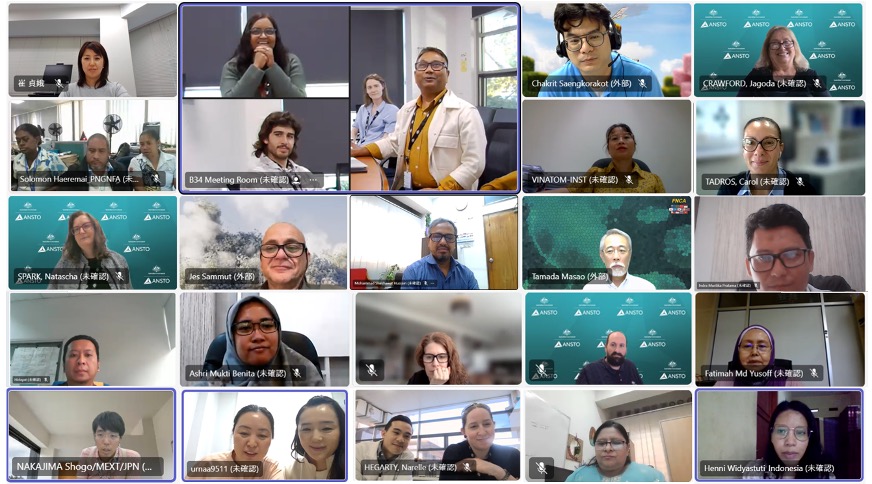
FY2025 FNCA Workshop on CFF project was held online on September 4, 2025, hosted by ANSTO in Australia. The Workshop was attended by 35 participants from 10 countries, namely Australia, Bangladesh, Indonesia, Japan (observer), Malaysia, Mongolia, the Philippines, Thailand, Vietnam, and Papua New Guinea (observer), including workshop staffs.
The project aims to develop a food provenance technology platform and a federated database using priority food items to help mitigate incidents of fraud within the supply chain.
This year, an online meeting was held to review the progress of research being conducted in each country and to facilitate knowledge sharing. The progress of sample analyses for 2025 was reported by ANSTO, and it was demonstrated that a handheld XRF scanner is effective for elemental analysis of tiger prawns.
Summary of
FNCA 2025 Workshop on Combating Food Fraud
using Nuclear Technology Project
September 4, 2025
Online
The FNCA 2025 workshop on Combating Food Fraud using Nuclear Technology (CFF) project was held online on September 4, 2025.
The CFF project, approved at the FNCA Coordinators Meeting in June 2022, aims to develop a food provenance technology platform and a federated database using priority food items to help mitigate incidents of fraud within the supply chain. These outcomes will strengthen scientific capacity in applying nuclear technology to address biosecurity risks and adulteration issues in food systems.
The meeting this year was attended by 31 participants from FNCA Member States, along with four observers from Papua New Guinea (PNG). PNG expressed strong interest in the project, and their participation provided valuable opportunities for networking and collaboration.
Session 1
The opening session began with an Acknowledgement of Country by Ms. Susan Bogle (ANSTO), followed by welcome remarks from Ms. Natascha Spark (ANSTO), FNCA Coordinator from Australia and a presentation titled Radiation utilization and Prospects in FNCA by Dr. TAMADA Masao, FNCA Coordinator from Japan. This was followed by participant introductions.
Session 2
Dr. Debashish Mazumder (ANSTO), project leader of Australia, provided an overview of the project’s status, noting that most participating countries have collected samples of their selected food items to build data connectivity. An overview of the progress is shown in the table below.
Table 1. Sample analysis progress in 2025
| COUNTRY |
FOOD ITEMS |
PROGRESS |
| BANGLADESH |
Turmeric
Tiger Prawn |
Sample analysed at ANSTO lab and data provided |
| MALAYSIA |
Tiger Prawn
Mango |
Sample analysed at ANSTO lab and data provided |
| INDONESIA |
Vannamei Prawn and Rice |
Sample collection and analysis progressing in their labs
Henni Widyastuti (BRIN): Collaborating with
UNSW and ANSTO on MPhil research into prawn provenance based on farming practices. |
| MONGOLIA |
TBA |
Methodology in preparation |
| PHILLIPENS |
Honey, Mango,
Tiger Prawn, and Coffee |
Sample collection and analysis progressing in their labs |
| THAILAND |
Tiger Prawn
Plum |
Sample collection and analysis progressing in their labs |
| VIETNAM |
Tiger Prawn
Rice |
Sample analysed at ANSTO lab and data provided |
Dr. Mazumder also presented the analysis outcomes, demonstrating the successful application of handheld XRF for elemental analysis of tiger prawns. The results revealed a clear distinction between farmed and wild samples based on their elemental profiles, a pattern consistently observed across samples from Australia, Bangladesh, Malaysia, and Vietnam. The provenance model achieved an accuracy of 88% in determining whether samples originated from farmed or wild sources.
Dr. Mazumder also presented the results of tiger prawn samples provided to ANSTO by Bangladesh, Malaysia, and Vietnam for handheld XRF analysis. The elemental profiles revealed distinct differences between Australian and Vietnamese tiger prawns, while some overlap was observed between Malaysian and Bangladeshi samples. The country of origin was identified with an accuracy of 85% using the machine learning model. These findings demonstrate the strong potential of provenance technology to verify seafood authenticity and underscore its scalability to other food products, helping to reduce fraud across the supply chain.
Participating countries also shared their involvement and progress in the CFF project:
- Dr. Roksana Huque, Bangladesh
Presented FT-IR analysis of black tiger prawn and turmeric to assess geographic origin and farming practices. Samples were collected from both wild and farmed sources, with metadata recorded. Elemental profiling combined with multivariate analyses (PCA, CDA) revealed strong regional and seasonal differentiation, enabling authentication, traceability, and detection of food fraud.
- Ms. Henni Widyastuti, Indonesia
Outlined the application of isotope and nuclear-based analytical methods to shrimp and rice for authenticity and traceability. The work addresses geographical indication, halal compliance, and fraud prevention. Collaboration with UNSW and ANSTO supports research into prawn provenance.
- Mr. Norman D.S. Mendoza, Philippines
The food authentication program covers organic products, honey, mango, coffee, and cacao. Honey research influenced national standards and expanded to nationwide sampling using XRF and isotope techniques. Mango studies apply isotopic fingerprinting and machine learning for origin verification, while coffee and cacao projects focus on stable isotope profiling.
- Mr. Mohd Noor Hidayat Adenan, Malaysia
Focuses on Harumanis mango (a premium GI product) and black tiger prawn. The objective is to build a scientific database using stable isotope and multi-element analysis (IRMS, XRF, ICP-MS, NAA) to develop authenticity and traceability models for these high-value commodities.
- Ms. Lkhagva Uranchimeg, Mongolia
Food fraud monitoring is new, with no legal framework or established system. Current efforts aim to develop analytical methods and benchmark international standards to ensure origin verification and prevent mislabelling of imported and domestic products. Activities are coordinated under the Agency for Standard and Meteorology, which operates five main laboratories.
- Dr. Chakrit Saengkorakot, Thailand
The project focuses on black tiger prawn provenance. Samples were collected from multiple provinces, with preparation completed for most sites. Comparative analysis using handheld XRF (Olympus vs. Niton) showed minimal differences across weight and time variables, supporting elemental profiling for origin authentication.
- Dr. Nguyen Thi Hong Thinh, Vietnam
Aims to build a stable isotope and multi-element fingerprint database for ST25 rice and black tiger prawn to support food authentication and traceability. Activities include regional sampling, IRMS and ICP-MS analysis, and capacity building for provenance verification of high-value export commodities.
Session 3
Dr. Debashish Mazumder presented the implementation plan for 2026. Under this plan, samples will continue to be analysed at ANSTO, with results shared with participating countries and stored in a central repository. A final workshop is scheduled for 2026, followed by drafting a multinational report and a manuscript based on pooled seafood data. The project also aims to present findings at scientific conferences and seek additional funding to strengthen research and traceability collaborations with Asian partners.
Ms. Patricia Gadd (ANSTO) expressed her gratitude to Dr. TAMADA for his continued support in managing FNCA projects. She also thanked representatives from participating countries for their valuable contributions during the workshop, which were instrumental in achieving the objectives of the CFF project.
Program of
FNCA 2025 Workshop on Combating Food Fraud
using Nuclear Technology Project
September 4, 2025
Online
(Sydney time)
| 13:00-13:30 |
Session 1: Opening
Facilitator: Dr. Debashish Mazumder (ANSTO)
- Acknowledgement of Country: Ms. Susan Bogle
- Welcome remarks: Ms. Natascha Spark
- Radiation utilization and Prospects in FNCA: Dr. TAMADA Masao
- Self-introduction of participants
|
| 13:30-15:40 |
Session 2: Knowledge sharing and progress update
Facilitator: Dr. Jagoda Crawford (ANSTO)
- Update: Combatting Food Fraud using Nuclear Technology: Dr. Debashish Mazumder
- Progress presentation by countries:
Bangladesh
Indonesia
Malaysia
Mongolia
Philippines
Thailand
Vietnam
|
| 15:40-16:00 |
Coffee Break |
| 16:00-17:00 |
Session 3: Workshop and discussions
Facilitator: Ms. Patricia Gadd (ANSTO)
- Project implementation plan and milestones (overall): Dr. Debashish Mazumder
- Experience and expectations from PNG and Fiji (participating as an observer): Mr. Solomon Haeremai
- Discussion: All delegates
- Closing and thanks: Ms. Patricia Gadd
|
|
List of Participants
FNCA 2025 Workshop on Combating Food Fraud
using Nuclear Technology Project
September 4, 2025
Online
Australia
Dr. Debasish Mazumder
ANSTO
Ms. Patricia Gadd
ANSTO
Ms. Susan Bogle
ANSTO
Mr. Dan Nicholls
ANSTO
Ms. Narelle Hegarty
ANSTO
Ms. Elizabeth Bell
ANSTO
Mr. Mitchell Lo
ANSTO
Dr. Jagoda Crawford
ANSTO
Dr. Carol Tadros
ANSTO
Mr. Jason Bertoldi
ANSTO
Ms. Natascha Spark
ANSTO
Ms. Kellie McCourt
ANSTO
Prof. Jasmond Sammut
University of New South Wales (UNSW)
Bangladesh
Dr. Roksana Huque
Bangladesh Atomic Energy Commission (BAEC)
Dr. Md. Shakhawat Hussain
Bangladesh Atomic Energy Commission (BAEC)
Indonesia
Ms. Henni Widyastuti
National Research and Innovation Agency (BRIN)
Mr. Indra Mustika Pratama
National Research and Innovation Agency (BRIN)
Mr. Ashri Mukti Benita
National Research and Innovation Agency (BRIN)
Malaysia
Mr. Mohd Noor Hidayat Adenan
Malaysian Nuclear Agency
Prof. Dr. Fatimah Md Yusoff
University Putra Malaysia
Mongolia
Ms. Lkhagva Uranchimeg
National Reference Laboratory for Food Safety
Sainjargal. D
National Reference Laboratory for Food Safety
The Philippines
Mr. Norman D. S. Mendoza
Philippine Nuclear Research Institute (PNRI)
Thailand
Mr. Chakrit Saengkorakot
Thailand Institute of Nuclear Technology (TINT)
Ms. Sasiphan Khaweerat
Thailand Institute of Nuclear Technology (TINT)
Vietnam
Dr. Thinh Nguyen Thi Hong
Institute for Nuclear Science and Technology
Vietnam Atomic Energy Institute (VINATOM)
Mr. Nguyen Duc Tam
Institute for Nuclear Science and Technology
Vietnam Atomic Energy Institute (VINATOM)
Observer
Papua New Guinea
Solomon Haeremai
PNG National Fisheries Authority
Matilda Kepang
PNG National Fisheries Authority
Tindora Matainaho
PNG National Fisheries Authority
Kenneth Yhuanje
PNG National Fisheries Authority
Japan
Dr. TAMADA Masao
FNCA Coordinator of Japan
Mr. NAKAJIMA Shogo
Ministry of Education, Culture, Sports, Science and Technology (MEXT)
Dr. SUZUKI Yaeko
National Agriculture and Food Research Organization (NARO)
Ms. CHE Jong-ah
Nuclear Safety Research Association (NSRA)
|
|
|