Report of
FNCA 2011 Workshops on Mutation Breeding Project
February 20 - 23, 2012
Bangkok, Thailand
FNCA 2011 Workshops on Mutation Breeding Project took place as follows;
Outline of Workshop
| i) Date: |
February 20th - 23rd, 2012 |
| ii) Venue: |
Bangkok, Thailand |
| iii) Host Organization: |
Rice Department (RD), Ministry of Agriculture and Cooperatives of Thailand (MOAC)
Thailand Institute of Nuclear Technology (TINT)
Ministry of Education, Culture, Sports, Science and Technology of Japan (MEXT)
|
| iv) Participants: |
Total 14 from 9 countries, Bangladesh, Indonesia, Japan, Korea, Malaysia, Mongolia, The Philippines, Thailand and Vietnam |
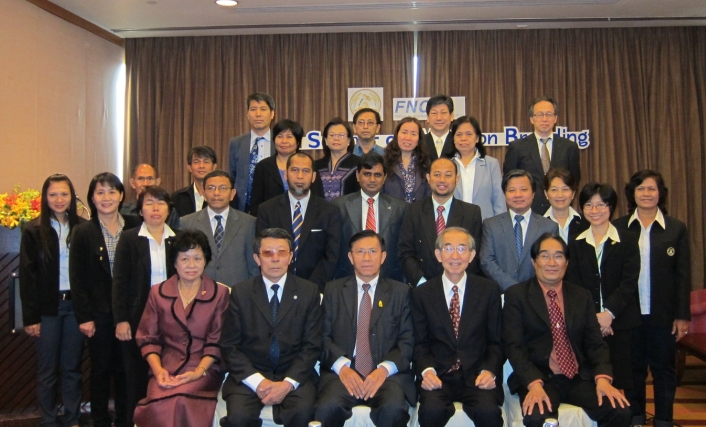
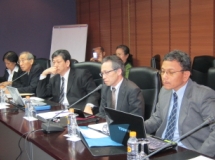
Participants of the Workshop & Open Seminar
Opening Session & Open Seminar
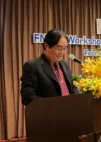
Mr. Chanpithya Chimpalee
|
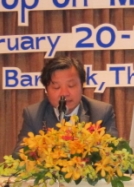
Mr. Chanpithya Chimpalee, Deputy Director General of Rice Department (RD), Ministry of Agriculture and Cooperatives of Thailand (MOAC), delivered welcoming remark and express warm welcome to all participants. In addition, Dr. Hirokazu Nakai, Project Leader (PL) of Japan delivered opening speech and thanked to Thailand for their hospitality to arranging this workshop. After group photo, Dr. Nakai gave a presentation for project review of FNCA Mutation Breeding Project and reported the result for 2010 workshop held in the Philippines.
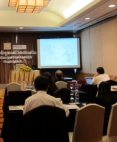
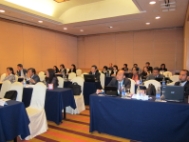
The open seminar was held on the first day of the workshop attended by ca. 30 participants from other agricultural department, universities, research institutes and members of FNCA Workshop.
Dr. Jinda Jan-Orn, Department of Agriculture of Thailand (DOA), presented success and perspective of mutation breeding for sustainable agriculture in Thailand.
Dr. Nakai gave a presentation for success stories of mutation breeding of rice. Some experimental results of studies on mutation breeding of rice for bacterial blight resistance through the use of thermal neutrons and ion beams were reported to discuss the usefulness of mutation breeding for future's agriculture.
Dr. Atsushi Tanaka, Japan Atomic Energy Agency (JAEA) delivered a presentation for advanced mutation breeding by the use of ion beams. He reported the characteristics of mutations induced by ion beams and introduced that many breeding programs are using mutants induced by ion beams and successfully producing useful plants such as ornamental flowers, new crop varieties, fruit, and trees, in Japan.
Dr. Sobri Bin Hussein, Malaysian Nuclear Agency (Nuclear Malaysia) has a significant roles in improving agriculture industries through mutation breeding and new mutants of crops, ornamental and medicinal plants have been produced, registered and subsequently commercialized in collaboration with industrial partners.
Session 1: Country Report and Conclusion of Country Report
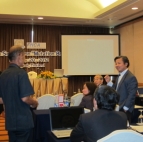
A total of 9 country reports on FNCA Mutation Breeding Project were presented. Then Dr. Tanaka summarized the problem facing in their projects and all participants discussed for the solution.
Session 3: Following up of Previous Sub-Projects
Malaysia and the Philippines reported on two sub-projects on Disease Resistance in Banana (terminated in 2010) and Insect Resistance in Orchid (terminated in 2009). It was successful to obtain 10 banana potential mutant lines resistant to BBTV (Banana bunchy top virus) in the Philippines, and 3 banana potential mutant lines tolerant to Fusarium and good agronomical characters such as high yielding, early flowering and short stature in Malaysia. And also it was obtained 3 orchid potential mutant lines tolerant to thrips and one mutant line tolerant to mite in Malaysia. Besides, Malaysia has also successful to develop banana micro propagation technique, green house and field screening methods for Fusarium, and orchid in-vitro screening method for insect. All products have been delivered to commercial market through private company.
Session 5: Cooperation with RCA/IAEA
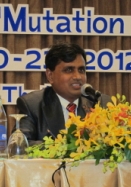
Dr. A.N.K. Mamun, Bangladesh Atomic Energy Comission (BAEC) delivered a lead speech for cooperation between FNCA and RCA/IAEA and all participants discussed on specific method of effective collaboration.
Future Plan and Conclusion
All participants discussed about research plan of Sub-Project on Composition and Quality in Rice for 2011-2012 and future plan of the project. Then the workshop was summarized as follows,
| 1) |
The present sub-project on composition or quality in rice showed almost all countries have proceeded their investigations and establishments of promising mutants matched with their demands, and therefore, will be finished in FY2012. |
| 2) |
The extension of commercialization and dissemination are well organized on the disease resistance in banana and insect resistance in orchid of the last sub-projects. |
| 3) |
In order to promote possible synergy of RCA and FNCA, it is strongly recommended that the workshop of RCA and FNCA for mutation breeding should be held together at least once in several years. |
| 4) |
Future plan of FNCA project for FY2013 - 2017 will be focused on mutation breeding for sustainable agriculture in Asia, i.e. for establishing resistance mutant varieties to various environmental stresses, early maturity, and low-input mutant varieties according to participating country's demands by using gamma-ray and/or ion-beam facilities, which should be shared in participating countries. |
| 5) |
It is also proposed that next workshop will be held in Indonesia or Malaysia, and include about two-day open symposium where experts on mutation breeding from host country and FNCA countries participate. |
Closing Session
Dr. Suniyom Taprab, RD, MOAC, and Dr. Nakai, delivered closing remarks and thanked to participants for their efforts and cooperation to this workshop.
Technical visit
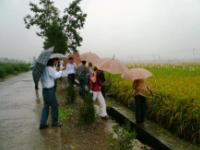
All participants visited to Nuclear Technology Research Center (NTRC) of Kasetsart University as a technical visit. At the bigining, Prof. Surapol Patharalorn, Dean of Faculty of Science delivered a welcoming speech, and Assoc. Prof. Peeranuch Jompuk made a presentation for introduction of NTRC. She reported the history of NTRC and overview of their activities. Then participants observed gamma room and mutants developed and released by the center.
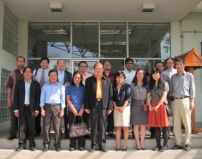
Nuclear Technology Research Center of
Kasetsart University
|
Prof. Surapol Patharalorn
|
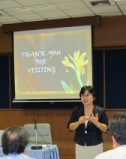
Assoc. Prof. Peeranuch Jompuk
|
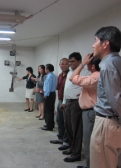
Gamma Room
|
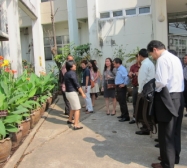
Mutant Varieties developed by NTRC
|
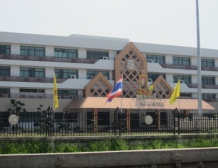
Rice Department of Thailand
|
Minutes of
FNCA 2011 Workshops on Mutation Breeding Project
February 20 - 23, 2012
Bangkok, Thailand
1) Outline of Workshop
| i) Date: |
February 20th - 23rd, 2012 |
| ii) Venue: |
Bangkok, Thailand |
| iii) Host Organization: |
Rice Department (RD), Ministry of Agriculture and Cooperatives of Thailand (MOAC)
Thailand Institute of Nuclear Technology (TINT)
Ministry of Education, Culture, Sports, Science and Technology of Japan (MEXT)
|
| iv) Participants: |
Total 14 from 9 countries, Bangladesh, Indonesia, Japan, Korea, Malaysia, Mongolia, The Philippines, Thailand and Vietnam |
| v) Program: |
Annex 1 |
2) Workshop Program
Opening Session
Mr. Chanpithya Chimpalee, Deputy Director General of Rice Department (RD), Ministry of Agriculture and Cooperatives of Thailand (MOAC), delivered welcoming remark and express warm welcome to all participants. In addition, Dr. Hirokazu Nakai, Project Leader (PL) of Japan delivered opening speech and thanked to Thailand for their hospitality to arranging this workshop. After group photo, Dr. Nakai gave a presentation for project review of FNCA Mutation Breeding Project and reported the result for 2010 workshop held in the Philippines. Participant list of the workshop is attached as Annex 2.
Open Seminar
The open seminar was held on the first day of the workshop attended by ca. 30 participants from other agricultural department, universities, research institutes and members of FNCA Workshop.
Dr. Jinda Jan-Orn, Department of Agriculture of Thailand (DOA), presented success and perspective of mutation breeding for sustainable agriculture in Thailand. He described on success of mutation breeding in rice, ornamental plants, mung bean and maize. Rice mutant varieties created great impact on the farmers and consumers in Thailand. These varieties could be used for very long period of time and broad adaptability. He also suggested that mutation breeding is environmental friendly and probably contributes organic farming and sustainability.
Dr. Nakai gave a presentation for success stories of mutation breeding of rice. Some experimental results of studies on mutation breeding of rice for bacterial blight resistance through the use of thermal neutrons and ion beams were reported to discuss the usefulness of mutation breeding for future's agriculture as follows ; (1) Induced mutation is to be useful for developing new genes which could be used as breeding materials. (2) Ion beam (high LET radiation) would be efficient mutagen for mutation breeding of crop plants. (3) Mutation breeding would contribute to nature or organic farming (low input sustainable agriculture). (4) Mutation and cross breeding could be combined depending on the breeding purpose to be efficiently completed.
Dr. Atsushi Tanaka, Japan Atomic Energy Agency (JAEA) delivered a presentation for advanced mutation breeding by the use of ion beams. He reported that the characteristics of mutations induced by ion beams are high frequency and broad spectrum, and produce novel mutants. He introduced that many breeding programs are using mutants induced by ion beams and successfully producing useful plants such as ornamental flowers, new crop varieties, fruit, and trees, in Japan.
Dr. Sobri Bin Hussein, Malaysian Nuclear Agency (Nuclear Malaysia) reported experience in commercial application of mutation breeding in Malaysia. He introduced that Nuclear Malaysia has a significant roles in improving agriculture industries through mutation breeding and new mutants of crops, ornamental and medicinal plants have been produced, registered and subsequently commercialized in collaboration with industrial partners.
Session 1: Country Report
A total of 9 country reports on FNCA Mutation Breeding Project were presented. The summaries of reports are attached as Annex 3.
Session 2: Summary and Conclusion of Country Report
The summary of country reports was presented by Dr. Tanaka. Country reports were not highlighted the problem facing in their projects. The meeting is suggesting that the participants can raise any problem of the project. The follwing shows some points of discussed problems.
| 1) |
Germination problem and fungal infection on irradiated seeds were occurred in Bangladesh and Malaysia. The solution is using 1% fungicide (Benlate) by soaking the irradiated seed in 1% fungicide solution for one night. |
| 2) |
After irradiation with ion beams, the seed can be stored longer, even a year under low temperature and dry condition. The temperature is suggested between 5 to15oC. To avoid reduction of seed viability, the seeds must be sown as soon as possible after received the irradiated seeds from Japan. The best moisture content for mutant induction is 13%. |
| 3) |
Analysing of amylose content and protocol of handling mutant line were discussed. The rapid method of selecting amylose content was suggested to use staining methods as early at M3 generation. FNCA should produce a protocol of handling mutant material from M1 generation from ion-beam radiation. |
| 4) |
The protein content in rice is thought to be correlated with eating quality. The protein is correlated with nitrogen uptake where contributing to yield production of rice. The protein content bellow 16% is considered lower. Low protein mutant is suitable for kidney patient. The longer the vegetative period the higher protein content. |
Session 3: Following up of Previous Sub-Projects
Malaysia and the Philippines reported on two sub-projects on Disease Resistance in Banana (terminated in 2010) and Insect Resistance in Orchid (terminated in 2009). The summaries of reports are attached as Annex 3.
It was successful to obtain 10 banana potential mutant lines resistant to BBTV (Banana bunchy top virus) in the Philippines, and 3 banana potential mutant lines tolerant to Fusarium and good agronomical characters such as high yielding, early flowering and short stature in Malaysia. And also it was obtained 3 orchid potential mutant lines tolerant to thrips and one mutant line tolerant to mite in Malaysia. Besides, Malaysia has also successful to develop banana micro propagation technique, green house and field screening methods for Fusarium, and orchid in-vitro screening method for insect. All products have been delivered to commercial market through private company.
Session 4: Mutation Breeding of Rice
Each PL from all participating countries had short presentation about major items of research plan during 2012 - 2013 and future plan. All countries have plans to continue further analysis of selected mutants as well as selection of new useful mutants in both projects of composition breeding and ion-beam irradiation breeding in rice. In near future, some of participant countries including Bangladesh, Indonesia, Korea, Malaysia and Vietnam, have a plan to apply to register as new varieties as an achievement of this sub-project. All participants also had discussed about some topics on rice mutation breeding, i.e., analysis technology of composition, application of ion-beam irradiation, screening method for biotic and abiotic stress resistant mutant, and cooperation ways among participant countries.
Session 5: Cooperation with RCA/IAEA
Dr. A.N.K. Mamun, Bangladesh Atomic Energy Comission (BAEC) delivered a lead speech for Cooperation between FNCA and RCA/IAEA.
The comprehensive discussion in session 5 highlighted the followings:
| 1) |
A meeting (at same time and same venue) should be held between PI or scientists of RCA and FNCA to discuss on possible collaboration once in a few years. |
| 2) |
Sharing of research facilities among participating countries should be feasible and encouraged in order to generate better research findings. |
| 3) |
Committee members suggested that FNCA should focus its roles on rice research while RCA will focus on other crops including rice. |
| 4) |
Committee members were also informed that Korea, Malaysia and the Philippines would focus on the RCA project for Kenaf, Rice and Mungbean, respectively while Bangladesh will be focusing on Rice and some other crops. |
Session 6: Future Plan of FNCA Project on Mutation Breeding of Rice
Dr. Minoru Nishimura, National Institute of Agrobiological Sciences (NIAS) presented the future plan of mutation breeding of rice. He gave emphasis on the kind of deletion ion beam had done on the mutants. He said it was small deletion. He concluded that we can increase the biomass of plants by mutation.
Prof. Le Huy Ham, Institute of Agricultural Genetics (AGI) presented the topic "Rice Breeding: the needs for improvement". He focused on the present situation of Vietnam in terms of food security issue and salinity torelance. He mentioned 'small rice' is the variety planted in the mountainous areas that are drought resistant, with high productivity and sustainable quality. He also added that they were importing good quality rice from Thailand and Taiwan for consumption.
Also, Dr. Nakai delivered a lead speech for future plan of FNCA Mutation Breeding Project, and all participants discussed and suggested as follows;
| 1) |
Workshop recommended organizing next FNCA workshop on the same place and the same time with RCA workshop to facilitate cooperation of these bodies. Duration of workshop will be 4 days, 2 first days for joined FNCA-RCA meeting, Two last days will be held as FNCA closing sessions. |
| 2) |
Particiapants expressed opinion that duration next phase of FNCA should be 5 years |
| 3) |
Dr. Si-Yong Kang, Korea Atomic Energy Research Institute (KAERI) will provide participants protocol for salinity screening after workshop. |
| 4) |
Dr. Nakai recommends selecting more than two seeds from each panicle of M1 for evaluation. Practically, we had better take whole panicles in bulk. |
| 5) |
Venue and time for the next meeting: Workshop consider necessary to choice host country for the meeting by turn, then Indonesia will be next for the next meeting. Indonesia representative agree to send proposal for the next workshop to Indonesia government and inform all participants in the next time. In the case of Indonesia can not host next workshop, Malaysia will be next host. |
Session 8: Confirmation of Minutes and Conclusion
As a conclusion, the workshop was summarized as follows,
| 1) |
The present sub-project on composition or quality in rice showed almost all countries have proceeded their investigations and establishments of promising mutants matched with their demands, and therefore, will be finished in FY2012. |
| 2) |
The extension of commercialization and dissemination are well organized on the disease resistance in banana and insect resistance in orchid of the last sub-projects. |
| 3) |
In order to promote possible synergy of RCA and FNCA, it is strongly recommended that the workshop of RCA and FNCA for mutation breeding should be held together at least once in several years. |
| 4) |
Future plan of FNCA project for FY2013 - 2017 will be focused on mutation breeding for sustainable agriculture in Asia, i.e. for establishing resistance mutant varieties to various environmental stresses, early maturity, and low-input mutant varieties according to participating country's demands by using gamma-ray and/or ion-beam facilities, which should be shared in participating countries. |
| 5) |
It is also proposed that next workshop will be held in Indonesia or Malaysia, and include about two-day open symposium where experts on mutation breeding from host country and FNCA countries participate. |
The Minutes was discussed and agreed upon by all participants. This will be reported at the 13th Coordinators Meeting to be held in March 2012, in Japan.
Closing Session
Dr. Suniyom Taprab, RD, MOAC, and Dr. Nakai, delivered closing remarks and thanked to participants for their efforts and cooperation to this workshop.
3) Technical visit
Kasetsart University
All participants visited to Nuclear Technology Research Center (NTRC) of Kasetsart University as a technical visit. At the bigining, Prof. Surapol Patharalorn, Dean of Faculty of Science delivered a welcoming speech, and Assoc. Prof. Peeranuch Jompuk made a presentation for introduction of NTRC. She reported the history of NTRC and overview of their activities. Then participants observed gamma room and mutants developed and released by the center.
4) Attachments
Program of
FNCA 2011 Workshops on Mutation Breeding Project
February 20 - 23, 2012
Bangkok, Thailand
| Day 1. Mon. 20th February |
| Opening Session |
| Chair: Dr. Suniyom Taprab, Thailand |
| 08:30 - 09:00
|
Registration |
| 09:00 - 09:15
|
Opening Address
Mr. Chanpithya Chimpalee, Deputy Director General of Department of Rice (DOR)
Dr. Hirokazu Nakai, Project Leader of Japan
|
| 09:15 - 09:25 |
Group Photo |
| 09:25 - 09:45
|
Project Review of FNCA Mutation Breeding Project
Dr. Hirokazu Nakai, Project Leader of Japan
|
| Open Seminar |
| Chair: Dr. Suniyom Taprab, Thailand |
| 09:45 - 10:15
|
1. Success and Perspective of Mutation Breeding for Sustainable Agriculture in Thailand
Dr. Jinda Jan-Orn, Department of Agriculture (DOA), Thailand
|
| 10:15 - 10:45
|
2. Success Stories of Mutation Breeding of Rice
Dr. Hirokazu Nakai, Shizuoka University
|
| 10:45 - 11:00 |
Break |
| 11:00 - 11:30
|
3. Advanced Mutation Breeding by the use of Heavy Ion Beams
Dr. Atsushi Tanaka, Japan Atomic Energy Agency (JAEA)
|
| 11:30 - 12:00
|
4. Experience in Commercial Application of Mutation Breeding in Malaysia
Dr. Sobri Bin Hussein, Malaysian Nuclear Agency (Nuclear Malaysia)
|
| 12:00 - 13:30 |
Lunch |
| Session 1. Country Report |
| Chair: Dr. A.N.K. Mamun, Bangladesh |
| 13:30 - 13:50
|
Bangladesh
Dr. A.N.K. Mamun, BAEC
|
| 13:50 - 14:10
|
Indonesia
Dr. Sobrizal, BATAN
|
| 14:10 - 14:30
|
Japan
Dr. Minoru Nishimura, NIAS
|
| 14:30 - 14:50
|
Korea
Dr. Si-Yong Kang, KAERI
|
| 14:50 - 15:10 |
Break |
| 15:10 - 15:30
|
Malaysia
Dr. Abdul Rahim Harun, Nuclear Malaysia
|
| 15:30 - 15:50
|
Mongolia (Short Presentation)
Dr. Jamyn Bekh-Ochir, Institute of Veterinary Medicine of Mongolia
|
| 15:50 - 16:10
|
The Philippines
Ms. Adelaida Barrida, PNRI
|
| 16:10 - 16:30
|
Thailand
Mr. Suniyom Taprab, DOR
|
| 16:30 - 16:50
|
Vietnam
Prof. Le Huy Ham, AGI
|
| |
| Day 2. Tue. 21st February |
| Session 2. Summary and Conclusion of Country Report |
| Chair: Dr. Abdul Rahim Harun, Malaysia |
| 09:00 - 10:00
|
Lead Speech
Dr. Atsushi Tanaka, Japan
Ms. Adelaida Barrida, The Philippines
Discussion for major conclusions leading the future direction and plan
|
| Session 3. Following up of Previous Sub-Projects |
| Chair: Dr. Sobrizal, Indonesia |
| 10:00 - 11:00
|
1. Sub-Project on Disease Resistance in Banana
Ms. Adelaida Barrida, The Philippines
Dr. Abdul Rahim Harun, Malaysia
|
| 11:00 - 11:10 |
Break |
| 11:10 - 12:00
|
2. Sub-Project on Insect Resistance in Orchid
Dr. Sobri Bin Hussein, Malaysia
|
| 12:00 - 13:00 |
Lunch |
| Session 4. Mutation Breeding of Rice |
| Chair: Dr. Si-Yong Kang, Korea |
| 13:00 - 17:00
|
1. Major items of research plan in 2012-13 and future plan in member countries
Short presentation by member countries (15 min. per country)
2. Common interests and objectives
(e.g. ion beam application, molecular technology, selection method)
3. How to implement cooperative research approaching common interests
|
| |
| Day 3. Wed. 22nd February |
| Session 5. Cooperation with RCA/IAEA |
| Chair: Dr. Sobri Bin Hussein, Malaysia |
| 09:00 - 10:30 |
Possible cooperation of FNCA with RCA/IAEA
Use of molecular techniques for mutation breeding of rice project
Lead Speech
Dr. A.N.K. Mamun, Bangladesh
|
| 10:30 - 11:00 |
Break |
| Session 6. Future Plan of FNCA Project on Mutation Breeding of Rice |
| Chair: Ms. Adelaida Barrida, The Philippines |
| 11:00 - 12:30
|
Lead Speech
Dr. Minoru Nishimura, Japan
Dr. Le Huy Ham, Vietnam
Discussion
|
| 12:30 - 13:30 |
Lunch |
| Cont. of Session 6. Future Plan of FNCA Project on Mutation Breeding of Rice |
| Chair: Prof. Le Huy Ham, Vietnam |
| 13:30 - 15:30
|
Lead Speech
Dr. Hirokazu Nakai, Japan
Conclusion by Dr. Hirokazu Nakai, Japan
|
| 15:30 - 16:00 |
Break |
| Session 7. Preparation of Minutes |
| Chair: Ms. Dao Thi Thanh Bang, Vietnam |
| 16:00 - 17:30 |
Preparation of Minutes by Chairs of Each Session |
| |
| Day 4. Thu. 23rd February |
| Session 8. Confirmation of Minutes and Conclusion |
| Chair: Dr. Atsushi Tanaka, Japan |
| 09:00 - 11:00 |
Confirmation of Minutes and Conclusion |
| 11:00 - 11:30 |
Break |
| 12:30 - 13:30 |
Lunch |
| Closing Session |
| Chair: Dr. Suniyom Taprab, Thailand |
| 11:30 - 12:00
|
Closing Remarks
1. Dr. Suniyom Taprab, Thailand
2. Dr. Hirokazu Nakai, Japan
|
| Technical Visit |
| 13:00 - 17:30 |
Kasetsart University |
List of Participants
FNCA 2011 Workshops on Mutation Breeding Project
February 20 - 23, 2012
Bangkok, Thailand
Bangladesh
Dr. ANK Mamun (PL)
Principal Scientific Officer
Institute of Food and Radiation Biology (IFRB)
Atomic Energy Research Estabulishment (Savar) (AERE)
Bangladesh Atomic Energy Commission (BAEC)
Indonesia
Dr. Sobrizal (PL)
Head of Agricultural Division
Center for the Application of Isotopes And Radiation Technology (PATIR)
National Nuclear Energy Agency(BATAN)
Japan
Dr. Hirokazu Nakai (PL)
Professor Emeritus, Former Vice President
Shizuoka University
Dr. Atsushi Tanaka
Senior Principal Researcher, Unit Manager
Medical and Biotechnological Application Division
Quantum Beam Science Directorate
Japan Atomic Energy Agency (JAEA)
Dr. Minoru Nishimura
Director
Institute of Radiation Breeding
Division of Genome and Biodiversity Research
National Institute of Agrobiological Sciences (NIAS)
Ms. Aki Koike (Secretariat)
International Affairs and Research Department
Nuclear Safety Research Association (NSRA)
Korea
Dr. Si-Yong Kang (PL)
Principal Researcher
Advanced Radiation Technology Institute (ARTI)
Korea Atomic Energy Research Institute (KAERI)
Malaysia
Dr. Sobri Bin Hussein
Research Officer
Agrotechnology and Biosciences Division
Malaysian Nuclear Agency (Nuclear Malaysia)
Dr. Abdul Rahim Harun
Manager, Agro-management Group
Agrotechnology & Biosciences Division
Malaysian Nuclear Agency (Nuclear Malaysia)
Mongolia
Dr. Jamyan Bekh-Ochir Bayan (PL)
Senior Research Worker
Institute of Veterinary Medicine of Mongolia
The Philippines
Ms. Adelaida C. Barrida (PL)
Senior Science Research Specialist
Philippine Nuclear Research Institute (PNRI)
Thailand
Dr. Suniyom Taprab (PL)
Senior Agricultural Scientist
Bureau of Rice Research and Development
Rice Department (DOR)
Ministry of Agriculture and Cooperatives (MOAC)
Viet Nam
Prof. Le Huy Ham (PL)
Director General
Institute of Agricultural Genetics (AGI)
Ms. Dao Thi Thanh Bang
Vice Head
Department of Genetics Engineering
Institute of Agriculture Genetics (AGI)
|